

Description
Introduction
Enterprise sales is one of the most challenging and rewarding areas of business growth. Unlike traditional sales processes that focus on quick transactions, enterprise selling involves complex decision-making, multiple stakeholders, longer sales cycles, and a greater focus on building trust.
Companies investing in large solutions expect sales professionals to understand their challenges, provide strategic insights, and demonstrate measurable value. Success requires much more than presenting a product—it requires strong communication, relationship building, negotiation skills, and a deep understanding of business needs.
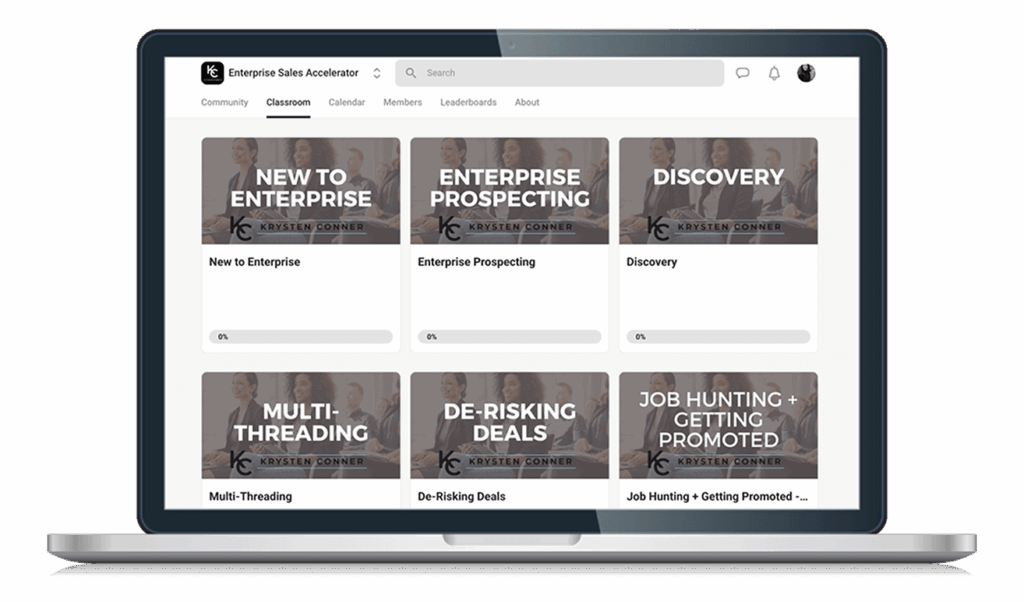
Krysten Conner – Enterprise Sales Accelerator focuses on helping sales professionals develop the skills and strategies needed to succeed in complex B2B environments. The program approach centers around improving sales effectiveness, strengthening client conversations, and creating repeatable systems for achieving consistent results.
This detailed guide explores the principles behind enterprise sales excellence, the importance of structured sales methods, and how professionals can improve their ability to close valuable business opportunities.
What Is Krysten Conner – Enterprise Sales Accelerator?
This program is designed to help sales professionals, business leaders, and revenue teams improve their approach to enterprise-level selling.
Enterprise sales requires a unique combination of:
- Strategic thinking
- Customer understanding
- Relationship management
- Communication skills
- Negotiation ability
- Business problem solving
The focus is not simply on increasing sales numbers but on developing a complete framework for creating meaningful business relationships.
A successful enterprise salesperson acts as a consultant rather than just a seller. They help organizations identify challenges, evaluate solutions, and make confident purchasing decisions.
The program emphasizes the importance of becoming a trusted advisor who can guide conversations with executives and decision-makers.
Understanding Enterprise Sales
Enterprise sales involves selling products or services to large organizations, corporations, and institutions.
Compared to smaller sales opportunities, enterprise deals often involve:
- Larger budgets
- Multiple decision-makers
- Longer evaluation periods
- More detailed requirements
- Greater focus on return on investment
A successful enterprise sales process requires careful planning and execution.
The salesperson must understand:
- Business objectives
- Company challenges
- Industry conditions
- Competitive landscape
- Internal decision processes
This level of understanding allows sales professionals to create solutions that align with customer goals.
Why Enterprise Selling Requires a Different Approach
Many traditional sales techniques focus on quick conversions and immediate results. Enterprise selling works differently.
Large organizations rarely make decisions based on a single conversation. Instead, purchasing decisions involve several stages.
Complex Decision-Making
Enterprise buyers often include:
- Executives
- Department leaders
- Finance teams
- Technical teams
- End users
Each person may have different priorities and concerns.
A successful salesperson must communicate value effectively to different audiences.
Longer Sales Cycles
Enterprise deals can take weeks, months, or longer to complete.
During this process, sales professionals must maintain engagement, provide useful information, and continue building trust.
Greater Emphasis on Value
Large organizations are not simply buying products. They are investing in outcomes.
They want to understand:
- How will this solve our problem?
- What business impact will it create?
- How does it compare to alternatives?
- What risks are involved?
Strong enterprise sellers focus on answering these questions.
The Importance of Sales Strategy and Process
A repeatable sales process creates consistency and improves performance.
Without a structured approach, sales teams often struggle with:
- Unqualified opportunities
- Poor follow-up
- Weak messaging
- Lost deals
- Unpredictable results
A strong enterprise sales framework typically includes:
Prospect Research
Understanding a potential customer before reaching out creates more meaningful conversations.
Research may include:
- Company goals
- Market position
- Current challenges
- Recent developments
- Business priorities
Qualification
Not every opportunity is worth pursuing.
Effective qualification helps sales professionals identify whether:
- The customer has a real need
- The company has purchasing ability
- Decision-makers are involved
- Timing is appropriate
This improves efficiency and focuses energy on valuable opportunities.
Value-Based Conversations
Enterprise buyers respond better when conversations focus on business outcomes rather than product features.
Instead of saying:
“Our solution has these features.”
Successful sellers explain:
“This solution can help your organization achieve these specific results.”
Building Strong Enterprise Relationships
Relationships are at the center of successful enterprise sales.
Large organizations want to work with professionals who understand their business and provide genuine value.
Strong relationships are built through:
Trust
Trust develops when sales professionals are:
- Honest
- Reliable
- Knowledgeable
- Consistent
Active Listening
Understanding customer needs requires asking thoughtful questions and paying attention to responses.
Good sales conversations involve more listening than presenting.
Long-Term Thinking
Enterprise sales is not only about closing one deal.
Strong relationships can create:
- Renewals
- Expansions
- Referrals
- Long-term partnerships
Developing a High-Performance Sales Mindset
Successful enterprise sellers often share similar characteristics.
They approach sales with:
Confidence
Confidence comes from preparation, knowledge, and understanding customer challenges.
Curiosity
Great sellers continuously learn about industries, businesses, and market trends.
Resilience
Enterprise sales involves rejection and challenges. The ability to learn and improve is essential.
Strategic Thinking
High-performing professionals think beyond individual transactions and focus on long-term business impact.
- ext steps
The purpose is to remain helpful rather than simply asking for updates.
Negotiation Strategies for Larger Deals
Negotiation is a critical skill in enterprise sales.
Large contracts often involve discussions around:
- Pricing
- Implementation
- Timelines
- Features
- Service expectations
- Business terms
Successful negotiation is not about winning against the customer. It is about creating an agreement where both sides see value.
Important negotiation principles include:
Understand Customer Priorities
Different buyers value different outcomes.
Some may prioritize:
- Cost savings
- Speed
- Flexibility
- Long-term reliability
- Strategic advantages
Understanding priorities helps create better solutions.
Avoid Focusing Only on Price
Enterprise buyers often care more about value than the lowest cost.
A strong salesperson demonstrates:
- Business benefits
- Expected return
- Long-term advantages
- Problem-solving ability
Create Mutual Confidence
The best negotiations build trust.
Customers should feel confident that they are making the right decision and partnering with the right organization.
Scaling Enterprise Sales Performance
Growing enterprise sales requires more than individual skill. Organizations need systems, training, and consistent processes.
Sales Team Development
Strong teams continuously improve through:
- Training
- Coaching
- Feedback
- Performance analysis
Continuous learning helps sales professionals adapt to changing markets.
Data-Driven Improvement
Sales performance improves when teams analyze results.
Important metrics may include:
- Conversion rates
- Sales cycle length
- Revenue growth
- Customer acquisition cost
- Pipeline performance
Data helps identify what is working and where improvements are needed.
Collaboration Between Teams
Enterprise sales success often requires cooperation between:
- Sales teams
- Marketing departments
- Customer success teams
- Product specialists
- Leadership
Strong collaboration creates a better customer experience.
Benefits of Developing Enterprise Sales Skills
Improving enterprise sales abilities creates advantages for both individuals and organizations.
Higher Revenue Opportunities
Enterprise deals often represent significant business value, making strong sales skills highly valuable.
Better Customer Relationships
A consultative approach creates deeper partnerships instead of short-term transactions.
Increased Professional Growth
Sales professionals with enterprise skills often develop stronger:
- Communication abilities
- Leadership skills
- Strategic thinking
- Business understanding
More Predictable Growth
A structured sales approach helps companies build repeatable revenue systems.
Common Enterprise Sales Mistakes to Avoid
Selling Too Early
Presenting a solution before understanding the customer’s needs can weaken the conversation.
Better approach: Focus on discovery first.
Ignoring Decision-Makers
Enterprise purchases usually involve multiple stakeholders.
Better approach: Understand who influences decisions and address each person’s priorities.
Using Generic Messaging
Customers want solutions designed around their situation.
Better approach: Personalize communication based on research and business goals.
Failing to Follow a Process
Without structure, sales opportunities become unpredictable.
Better approach: Use a consistent framework for prospecting, discovery, negotiation, and follow-up.
Frequently Asked Questions
What is Krysten Conner – Enterprise Sales Accelerator?
It is a sales-focused framework designed to help professionals improve enterprise selling abilities, strengthen customer conversations, and create more effective sales processes.
Who can benefit from enterprise sales training?
Sales representatives, account executives, business owners, sales managers, and revenue teams can benefit from improving their enterprise selling skills.
Why is enterprise sales different from regular sales?
Enterprise sales involves larger organizations, longer decision processes, multiple stakeholders, and a greater focus on business outcomes.
What skills are important for enterprise sales success?
Key skills include:
- Strategic communication
- Discovery questioning
- Negotiation
- Relationship building
- Problem-solving
- Business understanding
Can enterprise sales skills be learned?
Yes. With structured training, practice, and real-world experience, professionals can improve their ability to manage complex sales opportunities.
Final Conclusion
Enterprise sales is not simply about selling a product or service. It is about understanding organizations, solving meaningful problems, and creating partnerships that deliver measurable value.
Krysten Conner – Enterprise Sales Accelerator represents a structured approach to improving the skills required for modern enterprise selling. By focusing on strategic conversations, customer relationships, effective sales systems, and value-based communication, professionals can improve their ability to handle complex business opportunities.
The strongest enterprise sales professionals are not just persuasive speakers. They are trusted advisors who understand customer challenges and help organizations make better decisions.
As businesses continue to compete in complex markets, the ability to build strong enterprise relationships and create consistent sales processes will remain one of the most valuable skills for long-term growth.


Reviews
There are no reviews yet.