

Description
Nicolas Cole & Dickie Bush – Decision Journaling 2026: An In-Depth, Honest Review
In the fast-paced landscape of online business, digital writing, and modern entrepreneurship, the bottleneck to progress is rarely a lack of information or effort. More often, it is poor decision-making under uncertainty. Creators and business owners routinely spend weeks or months stuck in mental loops—second-guessing pricing, overthinking content strategies, switching niches, or delaying product launches.
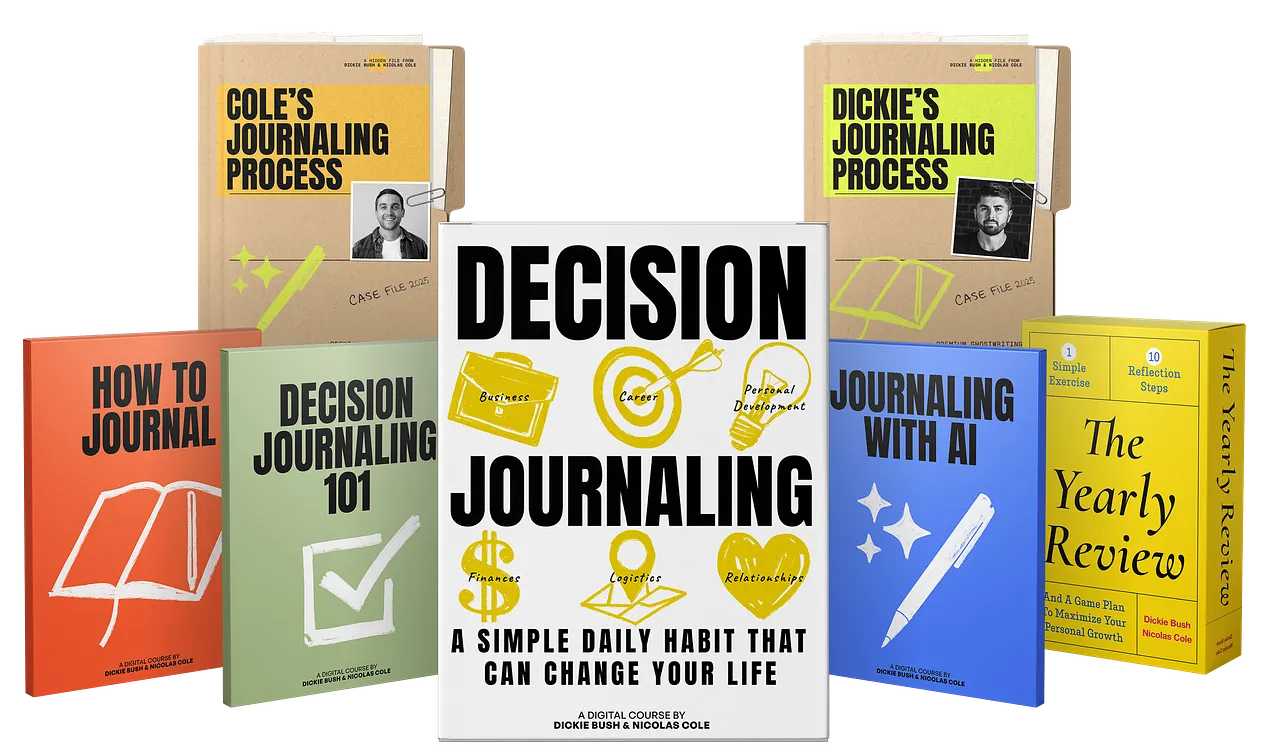
To solve this universal challenge, digital publishing pioneers Dickie Bush and Nicolas Cole introduced their framework: Nicolas Cole & Dickie Bush – Decision Journaling 2026. Designed as a deliberate operating system for your brain, this program bridges the gap between passive reflection and high-stakes executive execution.
If you have been wondering whether this methodology lives up to the hype, this comprehensive review breaks down what the system covers, how it functions, its key strengths and weaknesses, and whether it delivers a real return on your time and investment.
What Is Nicolas Cole & Dickie Bush – Decision Journaling 2026?
At its core, decision journaling is a structured practice used by top-tier investors, hedge fund managers, and high-growth founders to audit their thinking before and after making major choices. Instead of evaluating a decision purely based on its outcome (which is often influenced by luck or external variables), decision journaling tracks the quality of the thinking process at the time the decision was made.
In Nicolas Cole & Dickie Bush – Decision Journaling 2026, the duo adapts these traditional corporate and financial decision frameworks specifically for modern digital creators, online writers, solopreneurs, and knowledge workers.
Rather than maintaining a standard daily diary filled with unstructured thoughts, this framework teaches you how to treat every major choice—from launching a new cohort to altering your business model—as an explicit experiment with measurable variables, expected outcomes, and second-order consequences.
Core Pillars and Architecture of the System
The program is structured around a repeatable, modular system designed to reduce cognitive friction and eliminate decision fatigue. Here is a breakdown of the primary components taught in the curriculum:
1. The Pre-Decision Framing Protocol
Before committing to a significant move, the system requires you to document five critical metrics:
-
The Context & Current State: What exact problem are you trying to solve, and why now?
-
Assumptions & Beliefs: What must be true for this choice to yield a positive outcome?
-
Second and Third-Order Effects: What are the downstream consequences in 30 days, 6 months, and 2 years?
-
Variables & Unknowns: What information do you currently lack, and can you acquire it before deciding?
-
Expected vs. Worst-Case Scenarios: What is the probabilistic outcome versus the downside risk you are taking on?
2. The Emotional Audit
A unique addition by Cole and Bush is filtering decisions through emotional awareness. Creators often make reactive choices driven by FOMO (fear of missing out), burnout, or social validation. The training provides prompt sequences designed to isolate rational logic from temporary emotional states, preventing impulsive strategic pivots.
3. The Feedback Loop & Post-Mortem Audit
A decision journal is useless if it sits unread. The 2026 framework emphasizes scheduled 30-day, 90-day, and 6-month retrospective reviews. By comparing what you thought would happen against what actually happened, you systematically uncover your cognitive biases, overconfidence tendencies, and blind spots over time.
Key Frameworks Taught in the Program
The Asymmetric Risk Engine
One of the most actionable concepts in the program focuses on identifying asymmetric bets—choices where the potential downside is capped and manageable, but the upside is virtually uncapped. The curriculum walks you through how to evaluate business ideas, content channels, and partnerships through this lens so you consistently choose options with favorable risk-to-reward ratios.
Clear vs. Clever Strategy
Drawing from their flagship digital writing philosophy, Cole and Bush apply the “Clear over Clever” rule directly to strategic planning. Many entrepreneurs overcomplicate their workflows or product offerings because complex solutions feel more sophisticated. The decision journal prompts force you to simplify complex problems down to their most straightforward, high-leverage execution steps.
The “Speed to Velocity” Matrix
In fast-moving online markets, speed is simply moving fast, whereas velocity is moving fast in the correct direction. The framework helps you audit whether your daily micro-actions actually align with your macro business goals, ensuring you aren’t just staying busy while running in circles.
Who Is This Framework Built For?
The Nicolas Cole & Dickie Bush – Decision Journaling 2026 methodology is tailored for specific profiles of online workers:
-
Digital Writers & Content Creators: Who constantly struggle with niche selection, monetization strategies, content formats, and audience positioning.
-
Solopreneurs & Founders: Who operate without a board of directors or executive team to challenge their assumptions and need an objective sounding board.
-
Knowledge Workers & Freelancers: Who want to elevate their strategic thinking, transition from execution to high-value advisory roles, and manage their time with higher precision.
-
Overthinkers & Perfectionists: Who suffer from analysis paralysis and need a structured, repeatable template to finalize choices and move forward messy rather than standing still.
Pros and Cons: An Honest Evaluation
To keep this review balanced, let us look at where the framework shines and where it might fall short for certain users.
The Strengths (Pros)
-
High Operational Clarity: Removes emotional fuzziness from business planning and replaces it with structured, step-by-step prompts.
-
Tailored for the Creator Economy: Unlike legacy management books that focus on corporate hierarchies, these templates are directly applicable to modern online business models.
-
Focuses on Process Over Outcome: Prevents you from penalizing yourself for good decisions that yielded bad luck, or rewarding yourself for poor decisions that got lucky.
-
Action-Oriented Formatting: Built for rapid copy-pasting into digital workspace tools like Notion, Typeshare, Obsidian, or Apple Notes.
The Drawbacks (Cons)
-
Requires Discipline: A decision journal only provides value if you maintain the habit and regularly conduct retrospectives. If you skip post-decision audits, the system loses much of its long-term potency.
-
Initial Friction: For individuals unaccustomed to structured meta-cognition, answering detailed pre-decision prompts can feel like extra work prior to taking action.
-
Not a Magic Bullet for Lack of Execution: Clarifying your decisions does not replace the hard work of building, writing, and executing daily.
Practical Application: How to Integrate It Into Your Workflow
To get the highest return from this system, integration should be kept as frictionless as possible:
-
Set Up a Centralized Hub: Create a single folder in your preferred note-taking tool dedicated exclusively to Decision Logs.
-
Establish Thresholds: Do not log micro-decisions like what to post on Twitter today. Reserve the decision journal for mid-to-high stake choices (e.g., pricing changes, hiring, course launches, strategy shifts).
-
Set Calendar Reminders for Reviews: When logging a decision today, immediately schedule a calendar reminder 60 or 90 days out to audit the entry and document lessons learned.
Final Verdict
Nicolas Cole & Dickie Bush – Decision Journaling 2026 is a powerful mental upgrade for anyone operating in the online space. By translating high-level executive decision theory into practical, creator-friendly templates, Cole and Bush have built a system that actively prevents expensive strategic mistakes and accelerates clarity.
If you are tired of running on the treadmill of indecision, second-guessing your direction, or repeating the same operational mistakes year after year, adopting this decision journaling protocol offers immense long-term leverage. It is not just a collection of journaling prompts; it is an executive operating system designed to turn messy thoughts into high-velocity execution.




Reviews
There are no reviews yet.