

Description
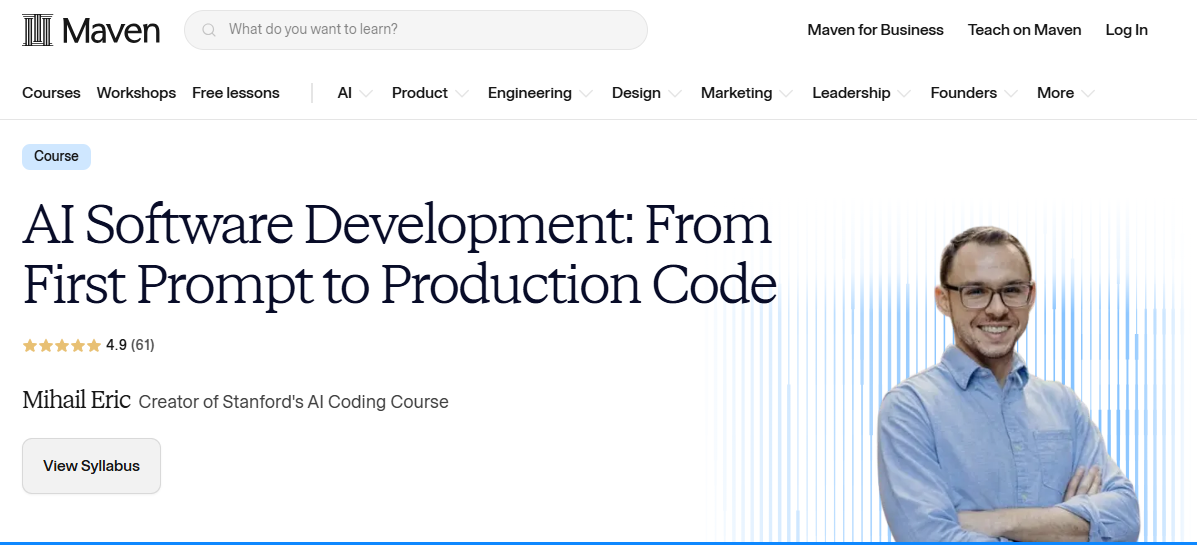
Mihail Eric – AI Software Development Review
Artificial intelligence is transforming software engineering faster than any previous technological shift. From AI-assisted coding to autonomous software agents, developers today have access to tools capable of generating code, debugging applications, writing documentation, creating tests, and even designing complete architectures. As organizations increasingly integrate AI into their development workflows, understanding how to build software with modern AI technologies has become a valuable professional skill.
Mihail Eric – AI Software Development is designed to help developers understand how AI can be incorporated into real-world software engineering. Instead of focusing only on theory, the course explores practical development workflows, modern AI frameworks, application architecture, deployment strategies, and the growing ecosystem surrounding large language models.
Whether you are an experienced software engineer, an aspiring AI developer, or a technical founder looking to integrate AI into your products, this program aims to provide a structured learning path that bridges traditional software engineering with today’s AI capabilities.
Course Overview
Artificial intelligence is no longer limited to research labs or large technology companies. Modern APIs, open-source models, cloud infrastructure, and AI development frameworks have made it possible for individual developers and small teams to build intelligent software products.
This course focuses on practical implementation rather than abstract machine learning theory. Students learn how modern AI applications are designed, structured, tested, deployed, and maintained using industry-standard development practices.
The curriculum introduces concepts that help developers understand how AI fits into the complete software development lifecycle instead of treating AI as a standalone technology.
What Makes This Course Different?
Unlike many beginner AI tutorials that only explain prompting techniques or simple chatbot creation, this training emphasizes software engineering principles.
Students learn how AI systems integrate into larger applications while maintaining code quality, scalability, security, and maintainability.
The course encourages developers to think like software architects rather than prompt engineers.
Topics generally include:
- AI-powered application development
- Software architecture
- Backend integration
- API design
- Prompt engineering fundamentals
- Retrieval systems
- AI agents
- Testing AI applications
- Deployment strategies
- Production best practices
Core Learning Areas
Modern AI Development
The course introduces the technologies currently powering modern AI applications.
Developers gain a better understanding of:
- Large Language Models
- Foundation Models
- AI APIs
- Open-source AI models
- Model selection
- Cost optimization
- Token management
These concepts form the foundation for building production-ready AI software.
Software Engineering Best Practices
Rather than replacing software engineering principles, AI enhances developer productivity.
Students learn how to:
- Structure maintainable codebases
- Build reusable components
- Create modular AI architectures
- Improve code readability
- Implement scalable backend systems
Good engineering practices remain essential when working with AI-powered applications.
Building AI Applications
One of the strongest aspects of modern AI education is learning through projects.
Students typically build applications involving:
- Intelligent assistants
- Document search
- AI chat interfaces
- Workflow automation
- Business productivity tools
- Internal company software
- Knowledge base assistants
Hands-on projects help reinforce theoretical concepts through practical implementation.
AI APIs and Integrations
Modern AI development often involves connecting external services into existing software systems.
Developers learn how APIs can be integrated into applications while managing:
- Authentication
- Rate limits
- Response handling
- Error management
- Performance optimization
- Cost efficiency
Understanding API architecture is critical for building reliable AI products.
Retrieval-Augmented Generation (RAG)
Many production AI systems require access to company-specific knowledge.
The course introduces Retrieval-Augmented Generation, allowing developers to create applications that can search documents before generating responses.
Common use cases include:
- Internal documentation
- Customer support
- Knowledge management
- Research assistants
- Enterprise search
This technique helps improve answer accuracy while reducing hallucinations.
AI Agents
Autonomous AI agents represent one of the fastest-growing areas in software development.
Students explore how intelligent agents can:
- Complete multi-step tasks
- Use external tools
- Search databases
- Generate reports
- Execute workflows
- Automate repetitive operations
Understanding agent architecture prepares developers for next-generation software applications.
Deployment and Production
Building an application is only part of the development process.
The course also discusses production considerations such as:
- Cloud deployment
- Monitoring
- Logging
- Security
- Scalability
- Version control
- Model updates
These practices help developers create reliable AI-powered software for real users.
Skills You Can Develop
After completing the course, learners may gain experience in:
- AI application architecture
- Software engineering
- Backend development
- AI workflow design
- API integration
- Prompt engineering
- RAG implementation
- AI agent development
- Production deployment
- Application optimization
These skills are increasingly relevant across startups, enterprise software, and independent development projects.
Who Should Take This Course?
This course is suitable for:
Software Developers
Developers looking to integrate AI into existing applications while maintaining strong engineering practices.
Backend Engineers
Professionals building APIs, cloud services, and scalable software systems.
Full-Stack Developers
Developers interested in adding AI capabilities to web applications.
Startup Founders
Entrepreneurs creating AI-powered SaaS products or automation platforms.
Technical Product Builders
Individuals interested in rapidly developing intelligent software solutions using modern AI tools.
Benefits of Learning AI Software Development
Developers who understand AI integration often gain advantages such as:
- Faster product development
- Increased automation
- Better developer productivity
- More intelligent user experiences
- Reduced repetitive coding tasks
- Enhanced software capabilities
- Competitive technical skills
As AI adoption continues to expand, these capabilities are becoming increasingly valuable across industries.
Potential Career Applications
Knowledge gained from AI software development can be applied in roles such as:
- AI Software Engineer
- Backend Developer
- Full-Stack Developer
- Machine Learning Engineer
- AI Product Engineer
- Automation Developer
- SaaS Founder
- Technical Consultant
Many organizations are actively exploring AI integration, creating opportunities for developers with practical implementation experience.
Is This Course Worth Considering?
For developers interested in practical AI implementation rather than purely academic machine learning, this course offers a structured introduction to modern AI software engineering concepts.
Instead of focusing solely on prompts or basic chatbot creation, the material emphasizes software architecture, production workflows, application development, and scalable engineering practices. Learners who already have programming experience are likely to benefit the most, as the course builds on existing development knowledge and demonstrates how AI can enhance modern software systems.
As with any technical training, the value depends on your goals, prior experience, and willingness to apply the concepts through hands-on practice. Developers who enjoy building real-world applications and experimenting with emerging AI technologies may find the course particularly useful as a starting point for creating production-ready AI solutions.
Final Thoughts
Artificial intelligence is reshaping how software is designed, built, and maintained. Developers who understand both traditional engineering principles and modern AI workflows are well positioned to create innovative applications that solve complex problems.
Mihail Eric – AI Software Development provides an educational overview of integrating AI into software engineering, covering application architecture, AI APIs, retrieval systems, autonomous agents, deployment, and production best practices. For developers seeking to expand their technical toolkit and stay current with evolving industry trends, the course offers a practical learning path focused on building intelligent software responsibly and effectively.




Reviews
There are no reviews yet.