
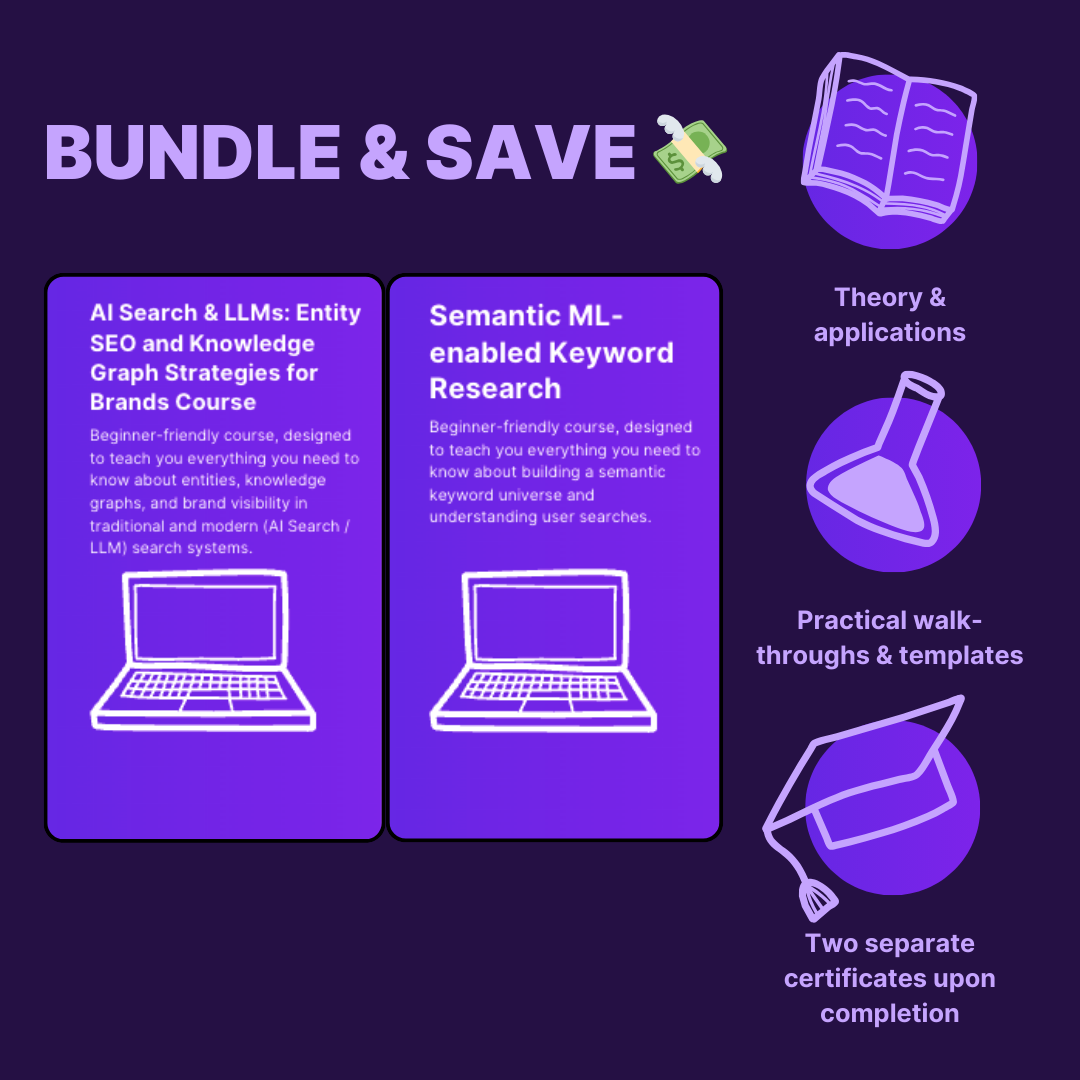

Description
Master Modern Search: An In-Depth Review of Lazarina Stoy – Semantic Keyword Research + AI Search & LLM Entity SEO
The landscape of search engine optimization has undergone its most fundamental shift since the introduction of RankBrain. Traditional keyword research—built around exact-match search volume, simple word repetition, and rigid keyword-to-page mapping—is no longer sufficient to guarantee visibility. As search engines evolve into conversational AI platforms powered by Large Language Models (LLMs) and vector embeddings, modern strategists need a completely new framework.
Enter Lazarina Stoy – Semantic Keyword Research + AI Search & LLM Entity SEO. This groundbreaking training and methodology bridges the gap between classic SEO practices and advanced information retrieval theory. Lazarina Stoy, a recognized leader in SEO automation and machine learning applications, has crafted an exhaustive blueprint for navigating entity-based indexing, knowledge graph alignment, and Generative Engine Optimization (GEO).
This detailed review explores the core concepts, technical depth, operational workflows, and overall value of this industry-defining framework.
The Paradigm Shift: Moving Beyond Exact-Match Keywords
For over two decades, search engines evaluated web content primarily through string-matching algorithms. SEO specialists found success by identifying phrases with high search volume and embedding them in specific page elements like H1 tags, meta descriptions, and body paragraphs.
However, modern search engines like Google, Bing, and AI-native engines like Perplexity or ChatGPT with Search do not read pages as simple strings of text. They convert text into mathematical representations known as vector embeddings. They parse content using Natural Language Processing (NLP) to extract entities (people, places, concepts, and objects) and establish relationships between them within vast knowledge graphs.
The Lazarina Stoy – Semantic Keyword Research + AI Search & LLM Entity SEO framework addresses this evolution head-on. Rather than teaching marketers how to target isolated words, Stoy delivers an actionable system for optimizing entire conceptual domains, establishing topical authority, and positioning content so that both search algorithms and LLMs recognize it as an authoritative source of truth.
Detailed Breakdown of the Core Curriculum
The course and framework are structured logically, guiding practitioners from theoretical foundations to technical execution and advanced AI integration.
Module 1: Foundations of Semantic Keyword Research
This opening module dismantles traditional keyword strategy and replaces it with vector-based semantic analysis.
-
Understanding Search Intent via NLP: Moving past basic intent categories (informational, transactional, navigational) into micro-intents and user goal state mapping.
-
Semantic Proximity and Clustering: Learning how search engines group queries based on conceptual similarity using machine learning models rather than word overlapping.
-
Vector Search Mechanics: Understanding how modern vector databases (like Pinecone, Qdrant, or Weaviate) store and retrieve information through dense embeddings.
Module 2: Entity Mapping & Knowledge Graph Alignment
The second module focuses on the heart of semantic SEO: entities and relationships. Stoy explains how search engines structure their knowledge bases and how content creators can anchor their brand within these graphs.
-
Entity Extraction: Utilizing NLP APIs (Google Natural Language API, SpaCy) to identify entities, salience scores, and sentiment in top-ranking content.
-
Schema Markup & Structured Data Integration: Moving beyond basic Schema.org markup to implement complex nested JSON-LD schema that explicitly defines entities, sameAs properties, and directional relationships.
-
Topical Authority Modeling: Designing site architectures and content hubs that cover an entity’s full graph, eliminating topical gaps that diminish search engine trust.
Module 3: AI Search Engines & LLM Optimization (GEO)
As users increasingly rely on generative answer engines, visibility is no longer just about position #1 on Google—it is about being cited in synthesized AI responses.
-
Generative Engine Optimization (GEO): Specific content structuring techniques designed to increase the probability of an LLM citing your page in generated responses.
-
Information Density & Retrieval Augmented Generation (RAG): Structuring content so that RAG systems can easily retrieve, chunk, and summarize your data accurately.
-
Optimizing for Perplexity, SearchGPT, and AI Overviews: Analyzing how different LLM-powered search platforms crawl, index, and surface source references.
Module 4: Practical Python, Data Analysis, and Automation
A defining highlight of Lazarina Stoy’s work is her practical approach to automation. She does not just teach concepts; she gives practitioners the technical tools to execute them efficiently.
-
Automated Keyword Clustering: Using Python scripts and scikit-learn/transformers to cluster thousands of keywords in minutes based on semantic embeddings.
-
Entity Extraction Scripts: Running custom Python code to analyze top-ranking competitors and extract entity gaps.
-
API Integrations: Connecting OpenAI, Google Cloud Natural Language, and SEO tools via custom scripts to scale semantic auditing across massive websites.
Comparing Traditional SEO vs. The Lazarina Stoy Semantic Framework
| Feature / Metric | Traditional Keyword Approach | Lazarina Stoy Semantic & LLM SEO Framework |
| Primary Focus | Target Keywords & String Matching | Entities, Relationships & Knowledge Graphs |
| Search Engine View | Text documents and backlinks | Structured vectors and semantic nodes |
| Content Optimization | Density, placement in headings/meta tags | Information density, salience scores, schema |
| Architecture | Siloed categories and flat tagging | Entity-based topic clusters and Graph models |
| AI Search Strategy | Rank tracking on traditional SERPs | GEO, RAG retrieval optimization, AI citation |
| Data Workflows | Manual Excel sorting & volume metrics | Python automation, embeddings, NLP APIs |
Key Standout Features of the Framework
1. Unmatched Technical Rigor
Unlike many high-level SEO courses that rely on surface-level advice, Lazarina Stoy backs every strategy with computer science principles. Practitioners gain a true understanding of how transformer models (BERT, RoBERTa, Gemini) parse syntax, extract subject-predicate-object triples, and index content.
2. Actionable Python Code & Templates
One of the main challenges with semantic SEO is scale. Manually mapping entities across hundreds of pages is impossible. Stoy solves this by providing functional Python notebooks and automation workflows. Even marketers with minimal coding experience can execute sophisticated data-driven clustering and entity mapping.
3. Forward-Looking Focus on Generative AI
Most current SEO methodologies were built for Google’s traditional 10 blue links. This framework is purpose-built for the AI-first era. By mastering Generative Engine Optimization (GEO), businesses ensure their visibility on AI Overviews, ChatGPT, Claude, Perplexity, and future conversational platforms.
Practical Application: Executing Semantic Entity Optimization
To understand the immediate real-world utility of Lazarina Stoy – Semantic Keyword Research + AI Search & LLM Entity SEO, consider the process for creating a piece of content under this methodology:
-
Entity Identification: Before writing a single word, run an entity extraction query on the top 10 ranking pages for the target topic to map core entities, secondary entities, and required salience levels.
-
Information Gap Analysis: Identify missing relationships or unanswered sub-questions that competitors have overlooked, increasing the unique information gain score of your content.
-
RAG-Friendly Formatting: Structure the text using clear contextual headers, direct answer paragraphs, tables, and structured lists that make it easy for LLM chunks to be parsed and cited.
-
Schema Definition: Implement custom JSON-LD schema that connects the page’s primary entity to established Wikidata and Wikipedia URIs using
aboutandmentionsschema properties. -
Vector Validation: Run the final text through embedding models to check semantic similarity against target query clusters before publishing.
Final Verdict: Is Lazarina Stoy’s Framework Worth It?
The Lazarina Stoy – Semantic Keyword Research + AI Search & LLM Entity SEO framework is an essential asset for modern digital marketers, technical SEOs, content strategists, and agency founders.
While beginner SEOs seeking basic link-building or basic WordPress setup guides might find the technical depth challenging, intermediate and advanced professionals will consider it a game-changer. Stoy demystifies complex machine learning concepts and translates them into operational strategies that drive measurable organic growth and AI search presence.
If you are serious about future-proofing your organic visibility, mastering vector search mechanics, and dominating both search engine results pages and AI generative engines, this comprehensive guide and framework represents the current gold standard in modern search engine optimization.




Reviews
There are no reviews yet.